3D perception without labels. Generative models for 3D structure.

Computer Vision PhD researcher at CTU Prague · ECCV, ICCV, WACV & IJCV papers · 2× winner of the CVPR S23DR challenge

Jan Skvrna

WireDiT accepted to WACV 2027

Our vertex-slot diffusion transformer for 3D wireframe reconstruction, the method behind our 1st place at the CVPR 2026 Structured Semantic 3D Reconstruction Challenge (following our 2025 win), was accepted to WACV 2027.

View Leaderboard

About Me

I am a PhD student at the Visual Recognition Group, Czech Technical University, advised by Lukas Neumann.

I work on two threads. Label-free 3D detection: training monocular and LiDAR 3D detectors with no human 3D annotations, using temporal consistency and off-the-shelf 2D vision models (TCC-Det, MonoSOWA, MonoSOWA++). Generative 3D reconstruction: diffusion transformers that turn sparse street-level captures into metric building wireframes (WireDiT), the method behind our two S23DR challenge wins.

Before the PhD I spent three years writing production C/C++ firmware, and I completed my MSc with honours and the Dean's Award for my thesis on 3D object detection.

3 Core A*/A Papers
1 Q1 Journal Paper
2x CVPR Challenge Winner

What I Build

Generative 3D reconstruction

Metric building wireframes from a short street-level capture

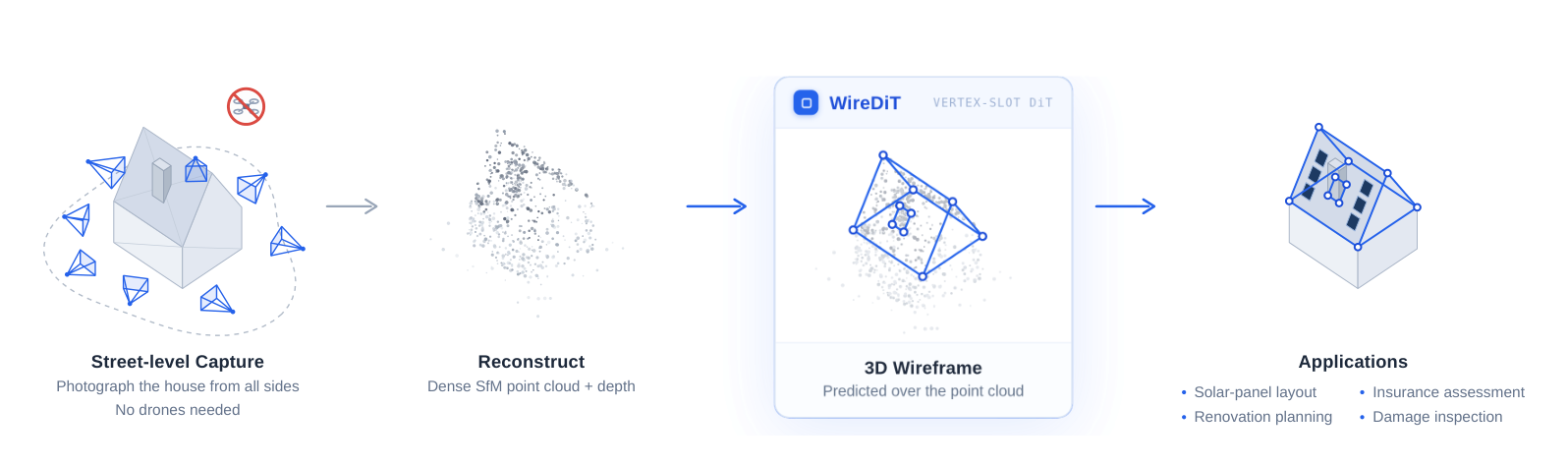
A few photographs of a house from the street, no drone, become a sparse SfM point cloud with monocular depth and semantics. WireDiT, a flow-matching diffusion transformer, denoises 64 vertex slots into a 3D wireframe while predicting which slots are real corners and how they connect. Scene tokens are anchored to real 3D points, so semantic evidence keeps its metric location; a hull-cropped second pass and a multi-sample consensus sharpen the corners. The output supports roof-area estimation, solar-panel layout, insurance assessment and renovation planning.

  • 0.654 HSS on unseen HoHo houses, state of the art (vertex F1 0.791)
  • 1st place at the CVPR S23DR challenge in 2026 and 2025
  • 68M parameters, trained on 4×H200, one house reconstructed in seconds

WireDiT (WACV 2027) · S23DR 2026 and 2025 winning solutions
Label-free 3D detection

3D object detectors trained without a single human 3D label

An autolabelling pipeline turns unlabelled driving video into 3D boxes: an off-the-shelf 2D instance segmentation model finds objects, temporal consistency across frames aggregates their points, and an outlier-robust template fit recovers metric size and pose. TCC-Det did this for LiDAR, MonoSOWA for a single moving camera by separating object from camera motion and normalising focal length across datasets, and MonoSOWA++ unified both into one fast pipeline with confidence-scored pseudo-labels and pedestrian and cyclist support.

  • 500× faster than the previous state of the art, 1.9 s per frame
  • 25% of KITTI labels plus pseudo-label pre-training beat training on 100%
  • SOTA among annotation-free methods on KITTI and the Waymo Open Dataset

TCC-Det (ECCV 2024) · MonoSOWA (ICCV 2025) · MonoSOWA++ (IJCV 2026)

Selected Publications

WireDiT pipeline: street-level capture, SfM reconstruction, predicted 3D wireframe, and applications
WACV 2027 · Accepted

WireDiT: A Vertex-Slot Diffusion Transformer for 3D Wireframe Reconstruction

A flow-matching diffusion transformer that reconstructs metric 3D building wireframes from sparse street-level SfM points, depth and semantics by denoising 64 vertex slots conditioned on point-anchored scene tokens. State of the art on HoHo (HSS 0.654, vertex F1 0.791) and Building3D, reconstructing a house in seconds. Paper and code coming soon.

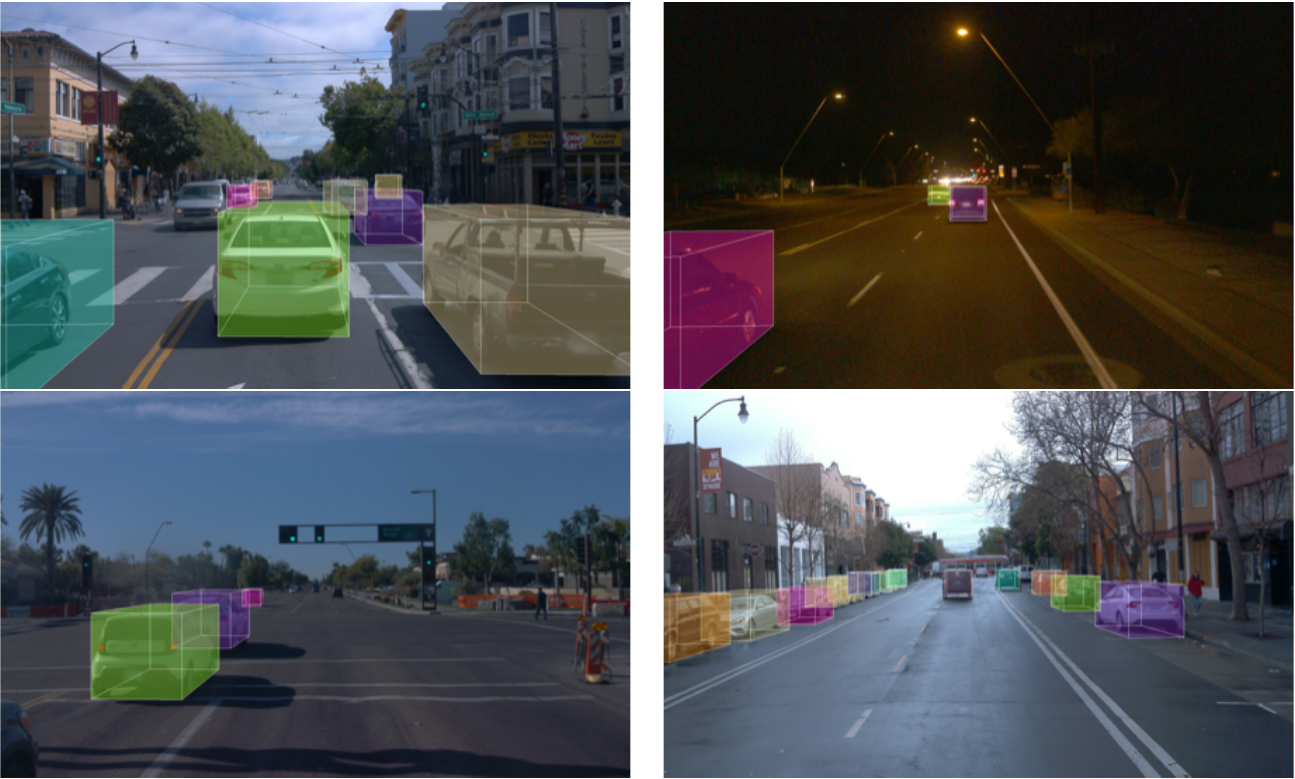
Qualitative MonoSOWA++ car detections on the Waymo Open Dataset
IJCV 2026

MonoSOWA++: Universal autolabeling pipeline for Monocular 3D object detection

A universal pipeline for training monocular 3D object detectors without domain-specific human annotations. It supports camera-only and LiDAR weak supervision, aggregates data across different camera setups, and is approximately 500× faster than prior work.

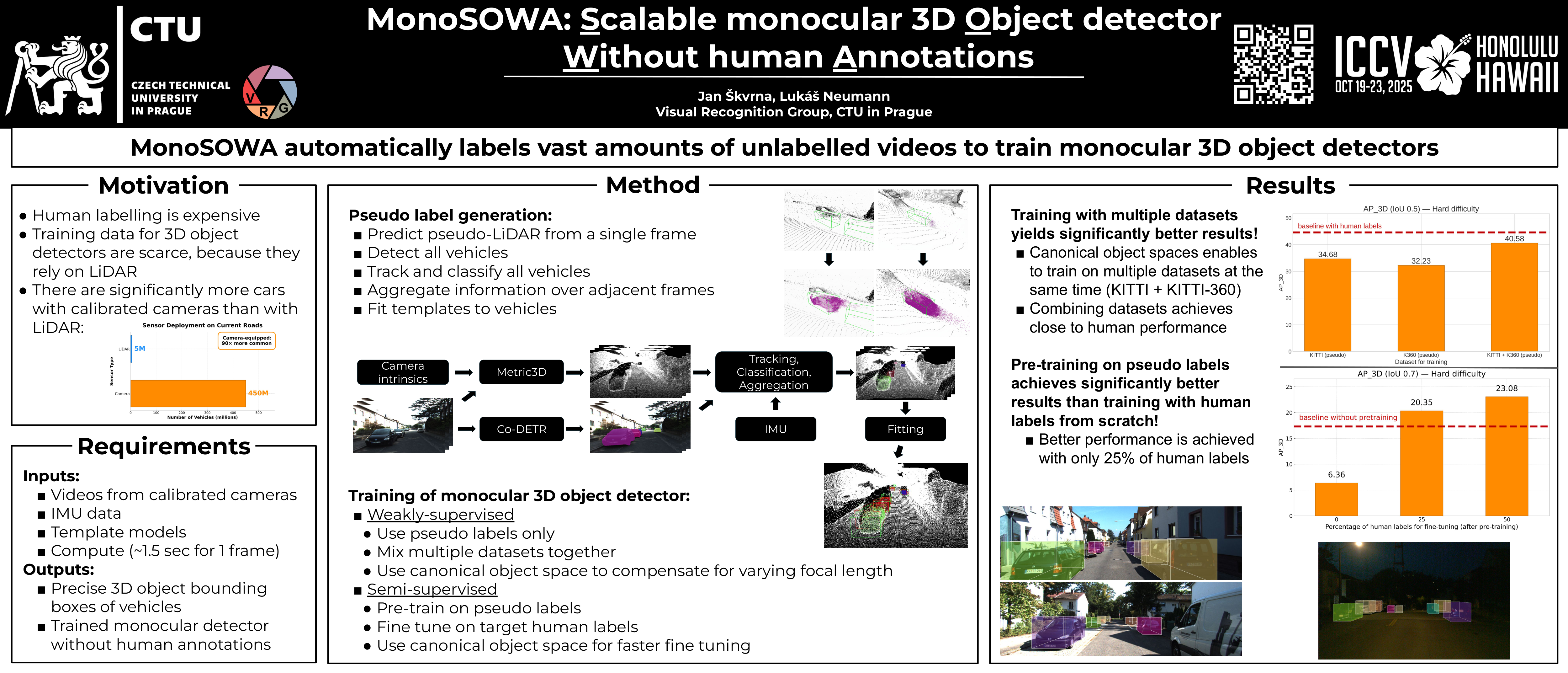
MonoSOWA Poster
ICCV 2025

MonoSOWA: Scalable monocular 3D Object detector Without human Annotations

A novel approach enabling 3D object detection from a single RGB camera without human annotations. Introduces a Local Object Motion Model with ~700× speedup over prior work.

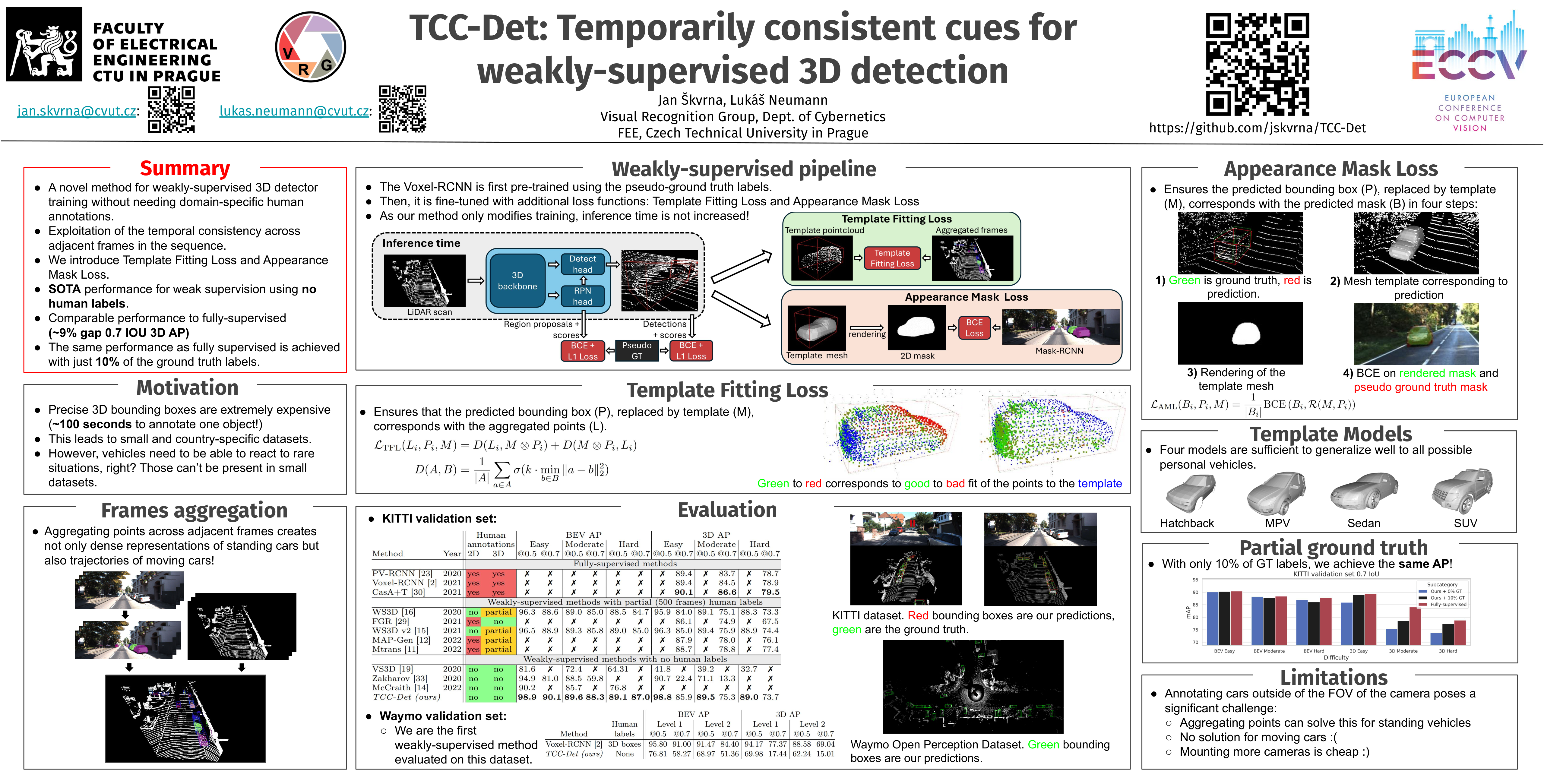
TCC-Det Poster
ECCV 2024

TCC-Det: Temporarily consistent cues for weakly-supervised 3D detection

Leveraging temporal consistency to train 3D detectors without 3D labels. Outperforms prior weakly-supervised methods on KITTI and Waymo datasets.

Background

Education

  • PhD in Informatics, CTU Prague, 2024 – 2027 (expected). Visual Recognition Group (Prof. Jiří Matas), advised by Dr. Lukáš Neumann.
  • MSc in Cybernetics and Robotics, with honours, CTU Prague, 2021 – 2024. Dean's Award for Exceptional Master's Thesis. Erasmus exchange at the University of Southern Denmark.

Industry & Teaching

  • Junior Embedded Software Developer, Poll s.r.o., 2020 – 2023. Real-time C/C++ firmware for ARM microcontrollers in HVAC and high-voltage DC/DC converter systems.
  • Lab Instructor, Deep Learning Essentials, CTU Prague, 2025 – present.

Talks

  • CMP Colloquium, Prague, 2026
  • Computer Vision Winter Workshop, Graz, 2025

Summer Schools

Reviewing

  • ICCV 2025, BMVC 2026, AAAI 2027

Skills

  • Modelling: diffusion and flow matching, DiT and Perceiver-style transformers, set prediction, 3D detection and structured reconstruction, multi-view geometry, weak and self-supervised learning.
  • Systems: Python, PyTorch (DDP, bf16, Slurm multi-GPU training), C/C++, CUDA, Linux, OpenCV, Open3D, PyTorch3D.